
Kausarul Bari
I’m passionate about Sales & Marketing and love using content as a powerful marketing tool. I’m a Teacher, Entrepreneur, Blogger, and always learning and growing to create impact through knowledge and creativity.
SubscribeHow to Choose the Right Technology to Build LLM Based AI Agents
Artificial intelligence is evolving faster than most businesses can keep up with. A few years ago, chatbots were considered advanced technology. Today, companies are building intelligent AI agents that can reason, plan, retrieve information, and perform tasks automatically. These systems are powered by Large Language Models (LLMs) and are changing industries like customer support, healthcare, finance, software development, and eCommerce.
The biggest challenge is not building an AI agent anymore. The real challenge is choosing the right technology stack. With hundreds of AI frameworks, models, vector databases, and deployment tools available, developers often struggle to decide which technologies are actually worth using.
Choosing the wrong tools can increase costs, slow performance, create security risks, and make scaling nearly impossible. That is why businesses need a clear strategy before starting development. The best AI agent stack depends on your goals, budget, infrastructure, and use case.
This guide explains how to choose the right technology for building LLM-based AI agents in a simple and practical way.
Understanding LLM-Based AI Agents
An LLM-based AI agent is more than a chatbot. Traditional chatbots simply respond to user input with predefined answers. AI agents can think through tasks, use external tools, remember previous conversations, and complete multi-step workflows.
For example, a simple chatbot may answer:
“What is the weather today?”
An AI agent can:
“Book a flight, reserve a hotel, update your calendar, and send a confirmation email.”
That difference is huge.
Modern AI agents usually include:
| Component | Purpose |
|---|---|
| Large Language Model | Handles reasoning and text generation |
| Memory System | Stores past interactions |
| APIs and Tools | Connects external services |
| Vector Database | Retrieves relevant information |
| Agent Framework | Controls workflows and tasks |
Businesses are investing heavily in these systems because they save time, reduce labor costs, and improve customer experiences.
Define the Purpose of Your AI Agent
Before selecting any technology, define exactly what your AI agent needs to do. This step is critical because every use case requires different tools.
If you are building a customer support agent, your priorities may include:
- Fast response times
- CRM integrations
- Low operating cost
- High scalability
If you are building a research or coding agent, you may need:
- Long-context reasoning
- Tool usage
- Web browsing
- Memory management
Enterprise workflow agents often require:
- Security compliance
- Audit logs
- Permission systems
- Human approval workflows
Think of your AI agent like building a car. A sports car, truck, and family SUV all serve different purposes. The same logic applies to AI technology choices.
Choosing the Right Large Language Model
The language model is the brain of your AI agent. Selecting the right one directly affects performance, speed, cost, and scalability.

Open Source vs Closed Source Models
This is one of the biggest debates in AI development today.
| Feature | Open Source Models | Closed Source Models |
|---|---|---|
| Cost | Lower long-term cost | Expensive API pricing |
| Privacy | Full control | Vendor dependency |
| Setup | More technical | Easier to use |
| Customization | High | Limited |
| Performance | Improving rapidly | Often stronger |
Closed-source models are usually easier for beginners because they offer managed APIs and reliable performance. However, API costs can become extremely expensive as traffic grows.
Open-source models are becoming very popular because businesses want better privacy and lower operational costs. Many companies now deploy smaller local models for internal workflows instead of relying completely on cloud providers.
The best choice depends on your budget and infrastructure capabilities.
Selecting the Best AI Agent Framework
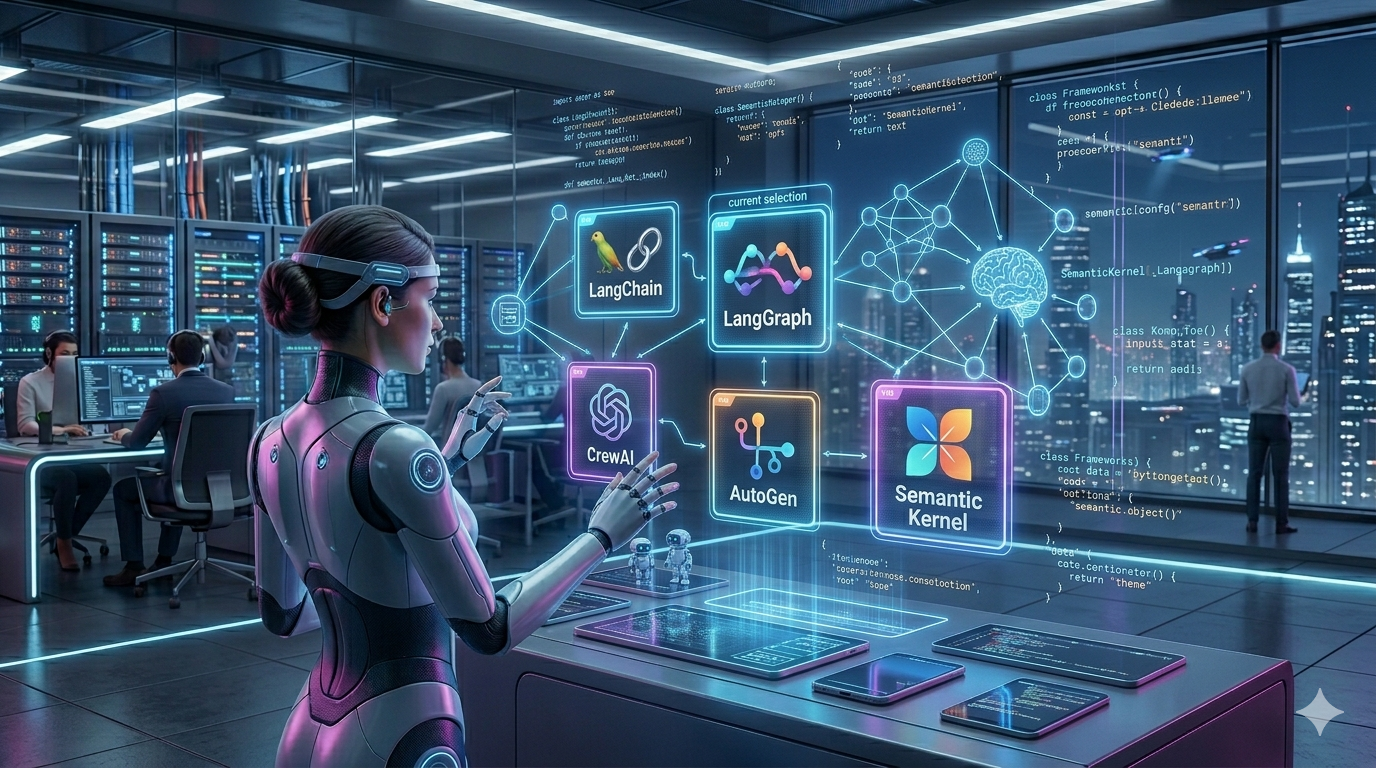
AI agent frameworks help developers manage workflows, memory, tools, and orchestration.
LangChain and LangGraph
LangChain became popular because it simplifies AI application development and supports many integrations.
LangGraph is gaining attention because it allows developers to create stateful workflows using graph-based architecture. This is especially useful for complex AI agents that need memory, decision-making, and multi-step reasoning.
LangGraph works well for:
- Multi-agent systems
- Human-in-the-loop workflows
- Persistent memory
- Complex automation
CrewAI and AutoGen
CrewAI focuses on collaborative AI agents. Developers can assign specialized roles such as researcher, writer, or analyst.
AutoGen is designed for multi-agent communication and autonomous problem-solving. It works well for advanced reasoning systems and research automation.
If your goal is rapid prototyping, CrewAI is often simpler. If you need highly autonomous systems, AutoGen may be a better choice.
Infrastructure and Deployment Decisions
Infrastructure is one of the most overlooked parts of AI development. Even the best AI agent can fail if deployment is poorly planned.
There are two main options:
| Deployment Type | Benefits | Challenges |
|---|---|---|
| Cloud Deployment | Easy scaling and maintenance | Higher recurring costs |
| Local Deployment | Better privacy and control | More technical complexity |
Cloud-based deployment is ideal for startups because it reduces infrastructure management. Local deployment is better for businesses handling sensitive data.
GPU requirements also matter. Large AI models require significant computational power, especially during inference. Many companies reduce costs using:
- Quantization
- Model compression
- Smart caching
- Smaller specialized models
Efficient infrastructure planning can save thousands of dollars every month.
Importance of RAG and Vector Databases
One of the biggest problems with AI models is hallucination. Models sometimes generate incorrect or outdated information.
This is where Retrieval-Augmented Generation (RAG) becomes essential.
RAG allows AI agents to retrieve information from external sources before generating responses. Instead of relying only on training data, the AI can access updated company documents, databases, or websites.
Popular vector databases include:
- Pinecone
- Weaviate
- Chroma
- Qdrant
These databases help AI agents search information semantically instead of relying only on keywords.
For enterprise AI systems, RAG is almost mandatory because businesses need accurate and updated responses.
Security and Cost Optimization
Security is becoming a major concern in AI development. AI agents can interact with APIs, databases, emails, and internal systems. Without proper controls, they can create serious risks.
Common risks include:
- Prompt injection attacks
- Data leakage
- Unauthorized tool access
- Hallucinated outputs
- Excessive API costs
To reduce these risks, businesses should implement:
- Permission management
- Human approval workflows
- Budget limits
- Monitoring systems
- Audit logs
Cost optimization is equally important. Many AI projects fail because infrastructure expenses become too high.
Businesses now reduce costs through:
| Optimization Method | Benefit |
|---|---|
| Prompt Compression | Lower token usage |
| Quantization | Reduced GPU requirements |
| Caching | Faster response times |
| Model Routing | Use cheaper models for simple tasks |
Using the right optimization strategy can dramatically improve profitability.
Future of AI Agent Technology
The AI agent industry is evolving rapidly. Developers are moving toward more autonomous, collaborative, and efficient systems.
Several trends are shaping the future:
- Multi-agent collaboration
- Local AI deployment
- Smaller specialized models
- Advanced memory systems
- Better governance and monitoring
One important shift is that infrastructure quality is becoming more valuable than model size alone. Reliable monitoring, security, and orchestration are now critical for production AI systems.
Businesses that focus on scalable and secure architecture today will have a major advantage in the future.
Conclusion
Choosing the right technology to build LLM-based AI agents requires more than following trends. The best technology stack depends on your use case, budget, scalability needs, and security requirements.
Start by clearly defining the purpose of your AI agent. Then choose the right language model, framework, infrastructure, and retrieval system based on those goals. Simplicity often wins over unnecessary complexity.
Frameworks like LangGraph, CrewAI, and AutoGen each offer different strengths. Open-source models provide flexibility and lower costs, while cloud-based solutions offer convenience and speed.
The AI industry will continue evolving quickly, but strong architecture fundamentals will always matter. Businesses that prioritize scalability, security, and cost optimization will build AI agents that succeed in real-world production environments.
FAQs
1. What is the best framework for AI agents?
LangGraph is excellent for complex workflows, while CrewAI is great for collaborative agents and rapid development.
2. Are open-source LLMs better than closed-source models?
Open-source models offer better control and lower costs, while closed-source models are usually easier to deploy.
3. Why is RAG important for AI agents?
RAG helps AI agents retrieve updated information, improving accuracy and reducing hallucinations.
4. What is the biggest challenge in AI agent development?
Scalability, infrastructure cost, and security are the biggest challenges for production AI systems.
5. Can small businesses build AI agents affordably?
Yes. Small businesses can use cloud APIs, lightweight frameworks, and smaller open-source models to reduce costs.
WRITTEN BY
Kausarul BariI’m passionate about Sales & Marketing and love using content as a powerful marketing tool. I’m a Teacher, Entrepreneur, Blogger, and always learning and growing to create impact through knowledge and creativity.